<?xml version="1.0" encoding="utf-8" standalone="yes"?><feed xmlns="http://www.w3.org/2005/Atom"><title>Logan's Blog</title><link rel="alternate" href="https://lberrymage.dev/"/><link rel="self" href="https://lberrymage.dev/index.xml"/><subtitle>Recent content on Logan's Blog</subtitle><id>https://lberrymage.dev/</id><generator uri="http://gohugo.io" version="0.144.0">Hugo</generator><language>en-us</language><updated>2024-03-20T00:00:00Z</updated><author><name>Logan Magee</name></author><rights>Copyright 2022-2024 Logan Magee</rights><entry><title>Ina, Part 1: Smaller, faster, and safer software updates for Accrescent</title><link rel="alternate" href="https://lberrymage.dev/posts/ina-part-1/"/><id>https://lberrymage.dev/posts/ina-part-1/</id><published>2024-03-20T00:00:00Z</published><updated>2024-10-10T18:06:40+02:00</updated><summary type="html">&lt;h1 id="introduction">Introduction&lt;/h1>
&lt;p>Well! It&amp;rsquo;s been a long time since I&amp;rsquo;ve shared an &lt;a href="https://accrescent.app">Accrescent&lt;/a> update here (most development
discussion takes place in our &lt;a href="https://matrix.to/#/#accrescent-space:matrix.org">Matrix rooms&lt;/a>), but today I have a big one: we&amp;rsquo;ve made significant
progress in developing delta updates!&lt;/p>
&lt;p>&amp;ldquo;That sounds great and fancy!&amp;rdquo; I hear you say, &amp;ldquo;but what in the world are delta updates, and why
would I care?&amp;rdquo;&lt;/p>
&lt;p>Well, to give a quick summary, delta updates bring your software update sizes from looking like
this:&lt;/p></summary><content type="html"><![CDATA[<h1 id="introduction">Introduction</h1>
<p>Well! It&rsquo;s been a long time since I&rsquo;ve shared an <a href="https://accrescent.app">Accrescent</a> update here (most development
discussion takes place in our <a href="https://matrix.to/#/#accrescent-space:matrix.org">Matrix rooms</a>), but today I have a big one: we&rsquo;ve made significant
progress in developing delta updates!</p>
<p>&ldquo;That sounds great and fancy!&rdquo; I hear you say, &ldquo;but what in the world are delta updates, and why
would I care?&rdquo;</p>
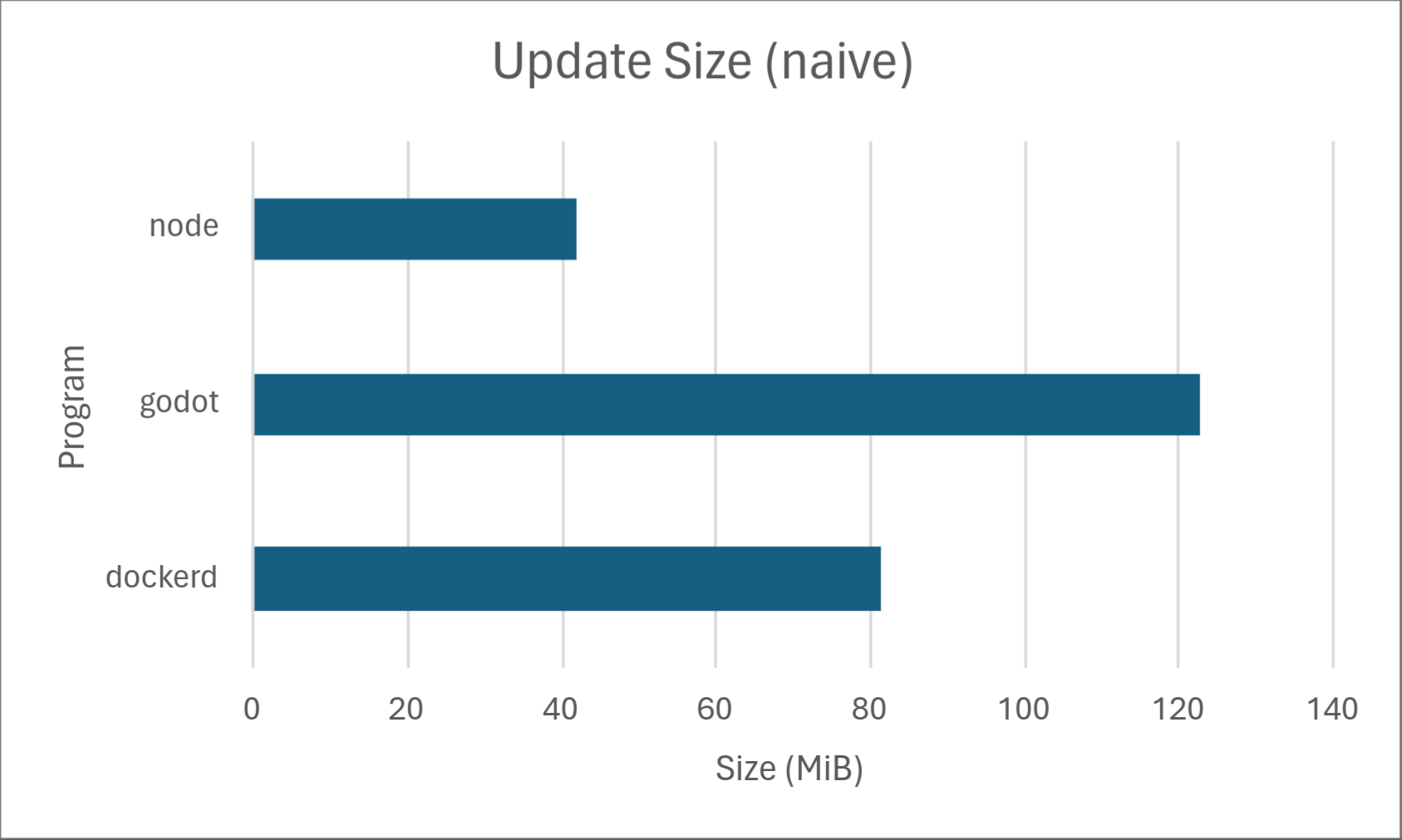
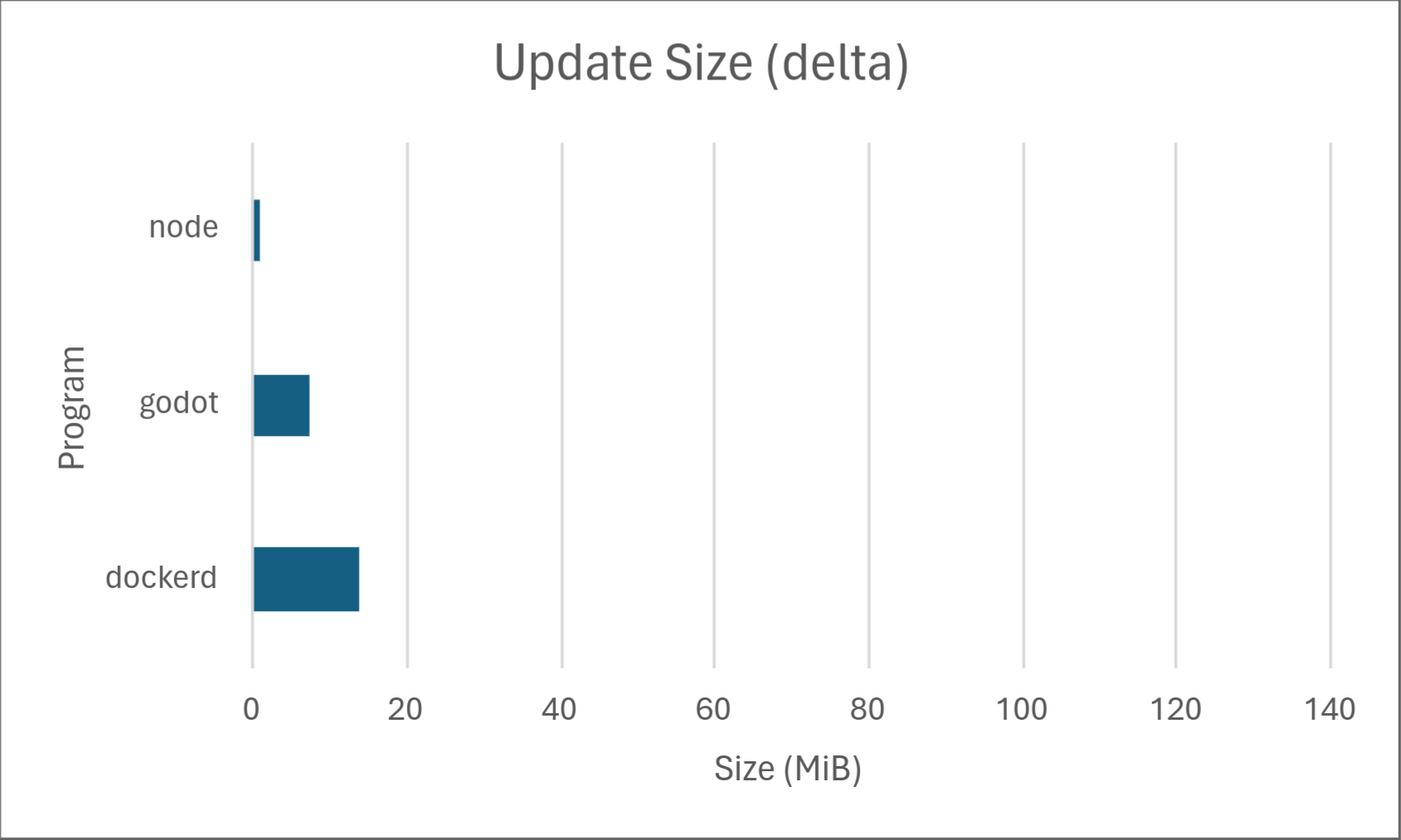
<p>Well, to give a quick summary, delta updates bring your software update sizes from looking like
this:</p>
<p><img loading="lazy" src="/delta-updates-naive.png" alt="Naive delta update sizes for various programs"  />
</p>
<p>to this:</p>
<p><img loading="lazy" src="/delta-updates-delta.png" alt="Delta update sizes for various programs"  />
</p>
<p>If you&rsquo;re curious as to how, keep reading. <sup id="fnref:1"><a href="#fn:1" class="footnote-ref" role="doc-noteref">1</a></sup></p>
<h1 id="background">Background</h1>
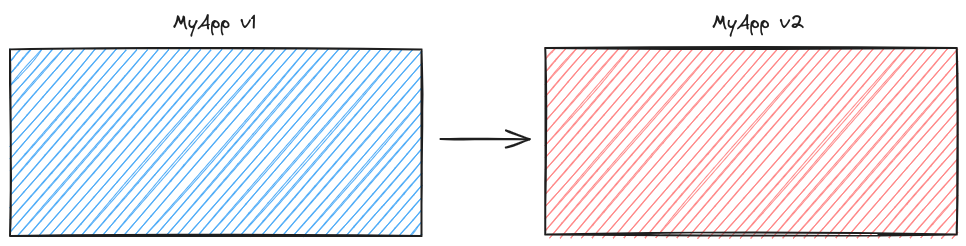
<p>In a basic software update system, the update process looks something like this:</p>
<p><img loading="lazy" src="/delta-updates-naive-visual.png" alt="Visualization of the naive approach"  />
</p>
<ol>
<li>Download the newest version of the software to disk.</li>
<li>Replace the old software files with the new ones.</li>
</ol>
<p>For the sake of convenience, we&rsquo;ll refer to this process as the &ldquo;naive approach.&rdquo;</p>
<p>There isn&rsquo;t anything <em>wrong</em> with the naive approach per se; it&rsquo;s simple, it works, and it&rsquo;s
relatively easy to implement. Many software update systems still work this way. However, when
working with wide-scale deployments, the naive approach suffers from a considerable issue: a full
copy of the latest software must be distributed to each client. <sup id="fnref:2"><a href="#fn:2" class="footnote-ref" role="doc-noteref">2</a></sup></p>
<p>This in turn causes higher bandwidth costs for both clients and the server operator, less frequent
updates (which may contain security fixes!), slower rollout, and more update interruptions which may
require starting the update over from the beginning. The client-facing issues are especially
troublesome in countries where Wi-Fi isn&rsquo;t commonplace and cellular data is slow and expensive.
Clearly, a solution to reduce these update sizes would be beneficial for both clients and the update
server operator. But how can we do this?</p>
<h1 id="attempt-1-data-compression">Attempt 1: Data compression</h1>
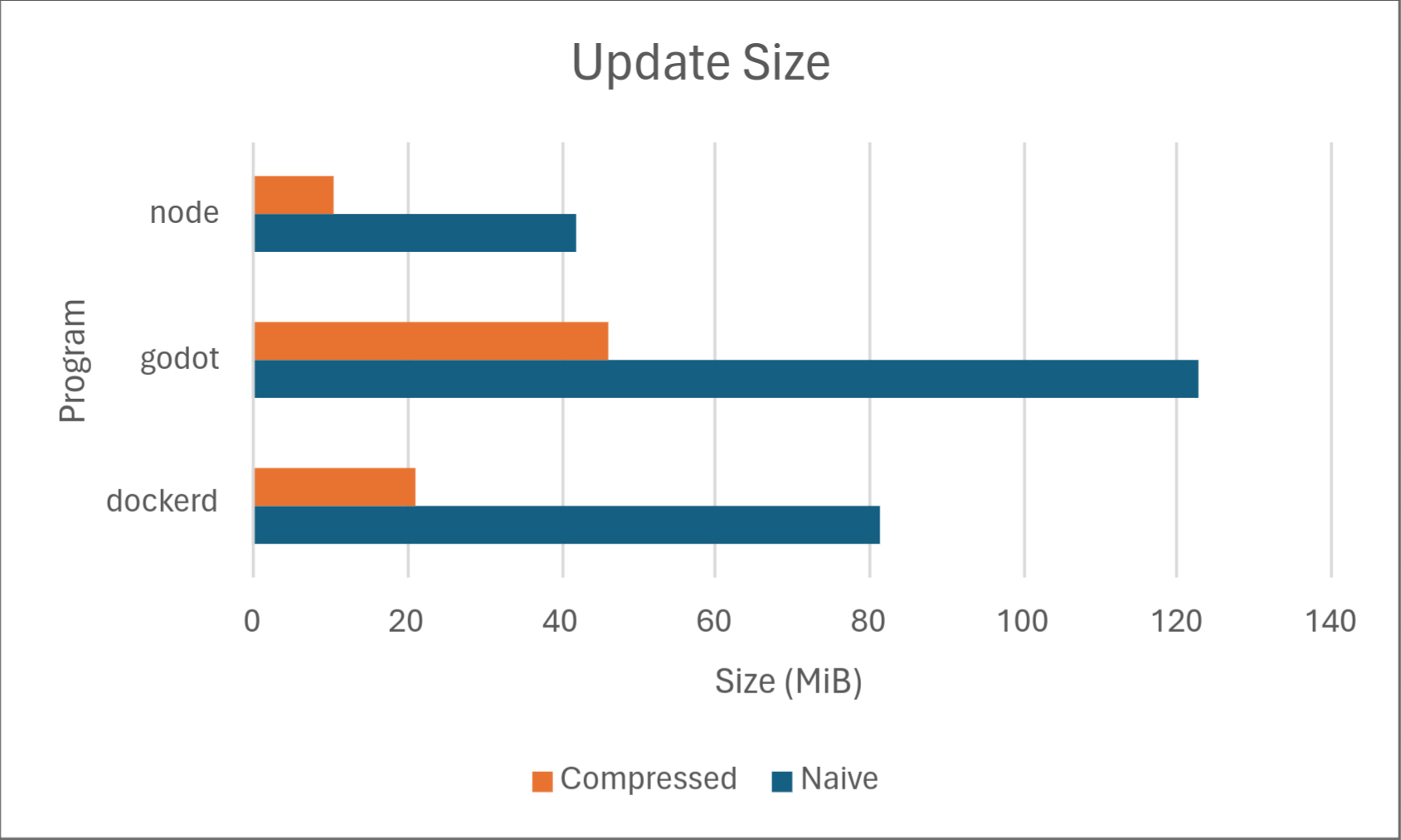
<p>Perhaps the most obvious first step to reduce update size is to apply generic data compression.
Using zstd at level 19, we get the following results:</p>
<p><img loading="lazy" src="/delta-updates-naive-compressed.png" alt="Compressed update sizes compared against the naive approach"  />
</p>
<p>Not bad! But these results are still far from the delta update sizes shown in the introduction. So
how can we possibly reduce them further?</p>
<h2 id="data-compression-in-theory">Data compression in theory</h2>
<p>While deep data compression theory is outside the scope of this article, a brief description of how
data compression works will help understand the approach to solving this problem. In general, data
compression algorithms exploit patterns in data to represent said data in fewer bytes. For example,
say we want to compress the sequence &ldquo;AAAA&rdquo;. We easily see that we&rsquo;re only using one character, A,
and that it repeats four times. We could design a compression scheme which exploits this pattern by
encoding it as a character followed by how many repeats of that character exist. <sup id="fnref:3"><a href="#fn:3" class="footnote-ref" role="doc-noteref">3</a></sup> In this
example, we could compress our input sequence to &ldquo;A4,&rdquo; a 50% size reduction.</p>
<p>Another important concept to understand is that the more you know about the type and format of the
data you&rsquo;re compressing, the more specific patterns you can detect and potentially exploit to reduce
compressed file size. Expanding the above example, let&rsquo;s say we know that our data contains only the
characters &ldquo;A&rdquo; and &ldquo;B.&rdquo; Thus, we can represent each character as 1 bit (0 representing A, and 1
representing B). If our length value is encoded as 8 bits, we can then represent &ldquo;A4&rdquo; in 9 bits (as
opposed to the 16 we would use if encoding &ldquo;A&rdquo; an as ASCII value).</p>
<p>With that out of the way, let&rsquo;s move on to delta updates!</p>
<h1 id="attempt-2-delta-updates">Attempt 2: Delta updates</h1>
<p>We&rsquo;ve discussed how data compression exploits patterns to represent data in fewer bytes. So what
patterns exist in software updates that we can exploit to reduce the size of our software updates?
As it turns out, there are two very important ones:</p>
<ul>
<li>The new software is usually very similar to the old software with some sparse changes.</li>
<li>The files being updated are usually executable software.</li>
</ul>
<p>We&rsquo;ll leave the second point up for discussion in part 2 of this series where we&rsquo;ll explain the
algorithm that Accrescent&rsquo;s delta update system uses in more detail. The first point is more
fundamental to delta update algorithms in general, and it prompts the question: if the new software
is mostly the same as the old software, what if we encoded <em>only the differences</em> between the two
and just copied data from the old software when it hasn&rsquo;t changed? That is, instead of viewing a
software update like this:</p>
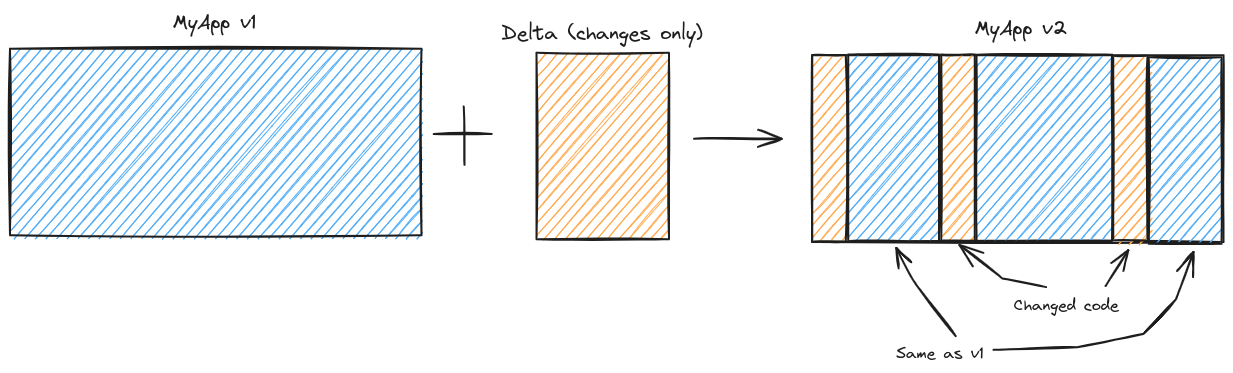
<p><img loading="lazy" src="/delta-updates-naive-visual.png" alt="Visualization of the naive approach"  />
</p>
<p>what if we viewed it like this:</p>
<p><img loading="lazy" src="/delta-updates-delta-visual.png" alt="Visualization of the delta update approach"  />
</p>
<p>and only sent the changes to the client? <sup id="fnref:4"><a href="#fn:4" class="footnote-ref" role="doc-noteref">4</a></sup></p>
<p>Here we have arrived at the concept of delta updates.</p>
<h1 id="our-solution">Our solution</h1>
<p>Delta updates themselves are not a novel idea. <a href="https://devblogs.microsoft.com/oldnewthing/20200212-00/?p=103434">Windows</a>, <a href="https://android-developers.googleblog.com/2016/07/improvements-for-smaller-app-downloads.html">Google Play</a>, <a href="https://www.chromium.org/developers/design-documents/software-updates-courgette/">Chrome</a>, <a href="https://source.android.com/docs/core/ota/tools#incremental-updates">Android</a>, and
more use some form of delta updates to reduce software update sizes. Some of these are partially or
<a href="https://chromium.googlesource.com/chromium/src/courgette/">completely</a> open-source, making it theoretically possible to adapt one of them for Accrescent&rsquo;s
usage. However, existing implementations suffer from some or all of the following issues, some of
them directly counter to Accrescent&rsquo;s goals:</p>
<ul>
<li>They are written in memory-unsafe languages like C and C++, making them <a href="https://nvd.nist.gov/vuln/detail/CVE-2014-9862">prone to security
vulnerabilities</a> and thus undesirable to use in a security-sensitive context.</li>
<li>They use an excess of main memory when diffing (creating a delta update) and/or patching (applying
a delta update), making them unsuitable for devices with low memory such as mobile phones and some
VPSs.</li>
<li>They have little to no testing, raising questions about their correctness and robustness against
bug classes outside of memory corruption (which can also be a security concern).</li>
<li>They have no Android library wrapper.</li>
</ul>
<p>Because of this, we decided to create a custom solution to the delta update problem with the
following goals:</p>
<ul>
<li>Memory-safe implementation language</li>
<li>Low memory requirements</li>
<li>Batteries-included Android library</li>
<li>Sandboxed Android patching</li>
<li>Thorough testing</li>
<li>Comparable diff and patch performance to existing implementations</li>
</ul>
<p>We&rsquo;re happy to say that this effort has been successful with all of the above goals met. <sup id="fnref:5"><a href="#fn:5" class="footnote-ref" role="doc-noteref">5</a></sup> We
call the resulting library &ldquo;Ina.&rdquo;</p>
<h1 id="performance-results">Performance results</h1>
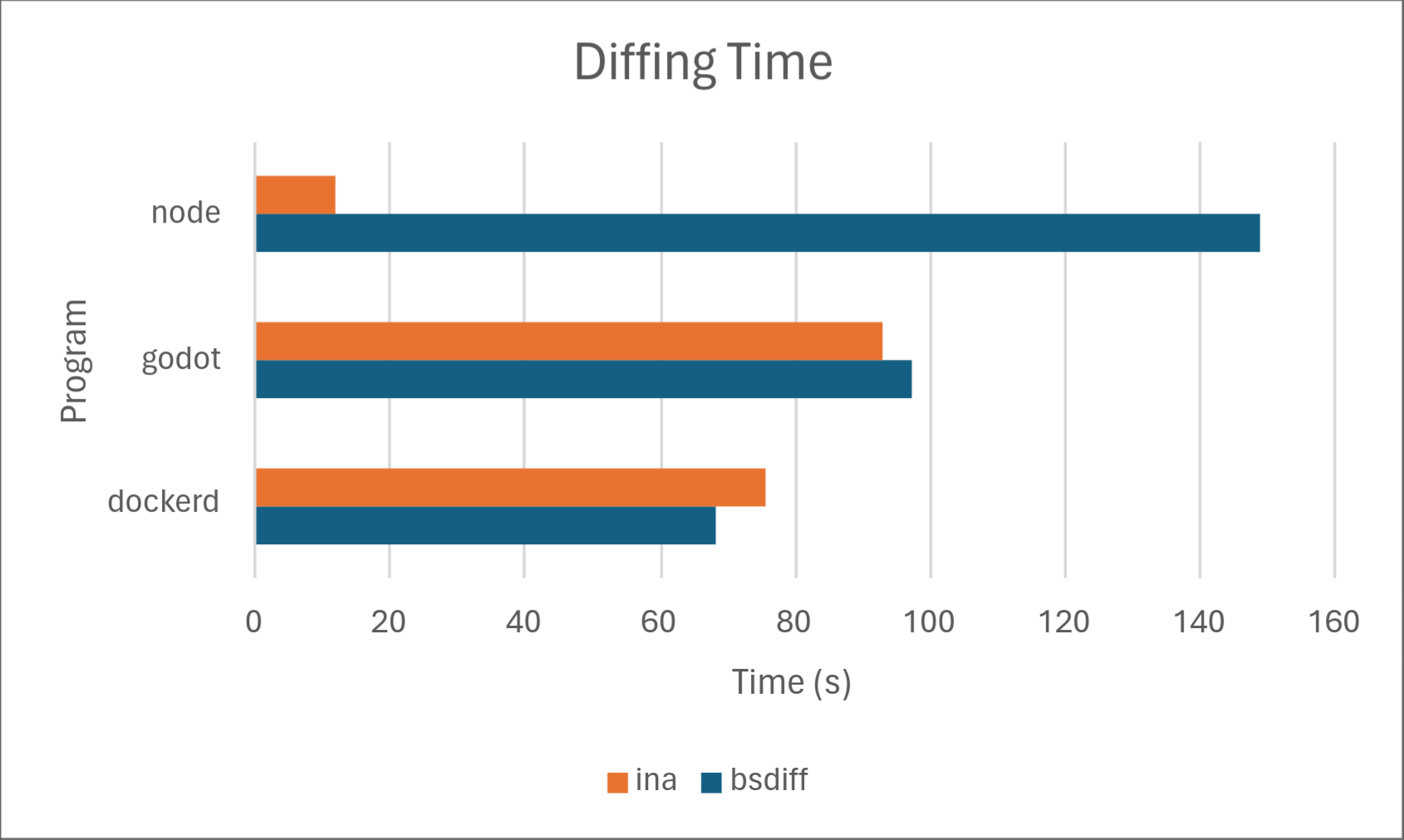
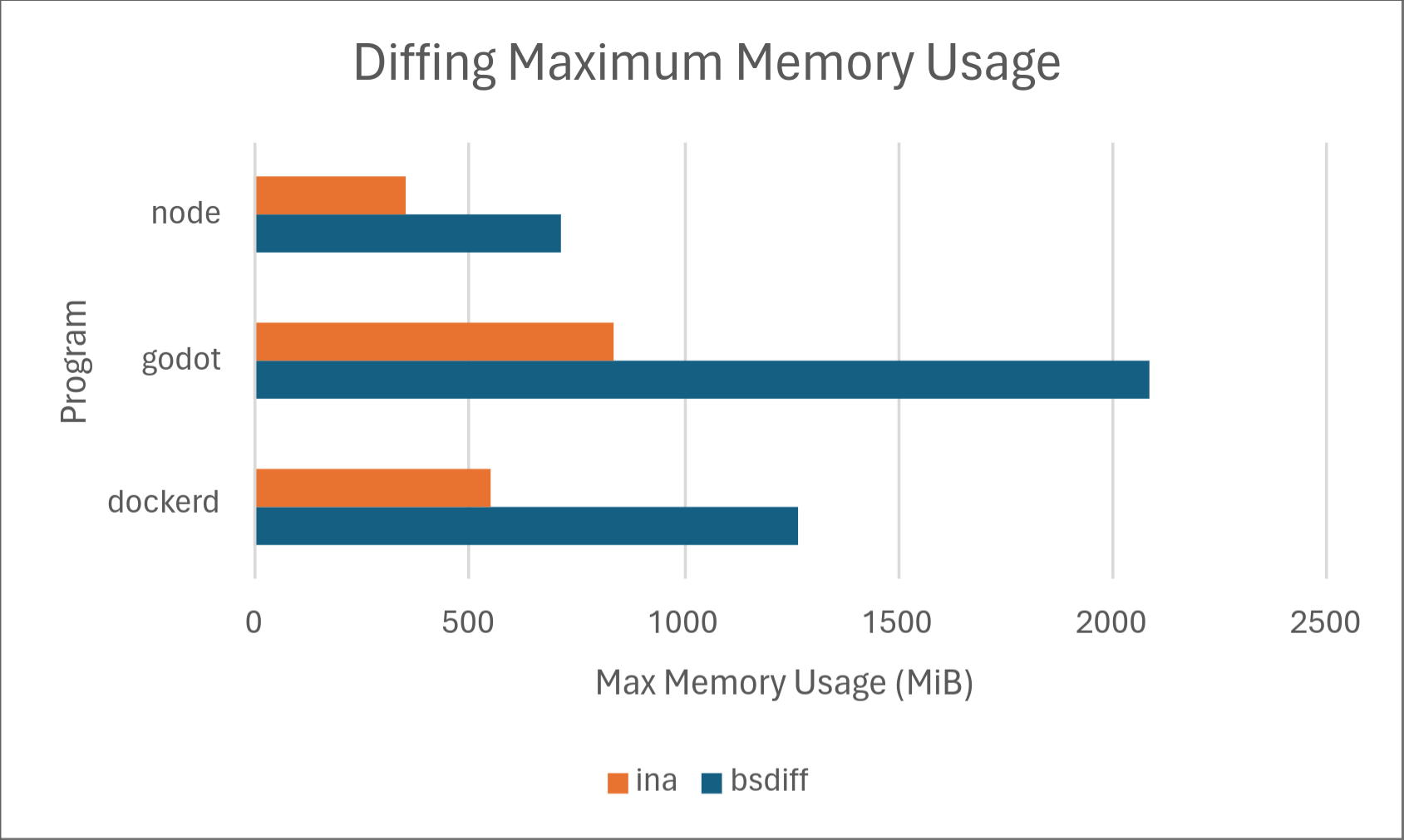
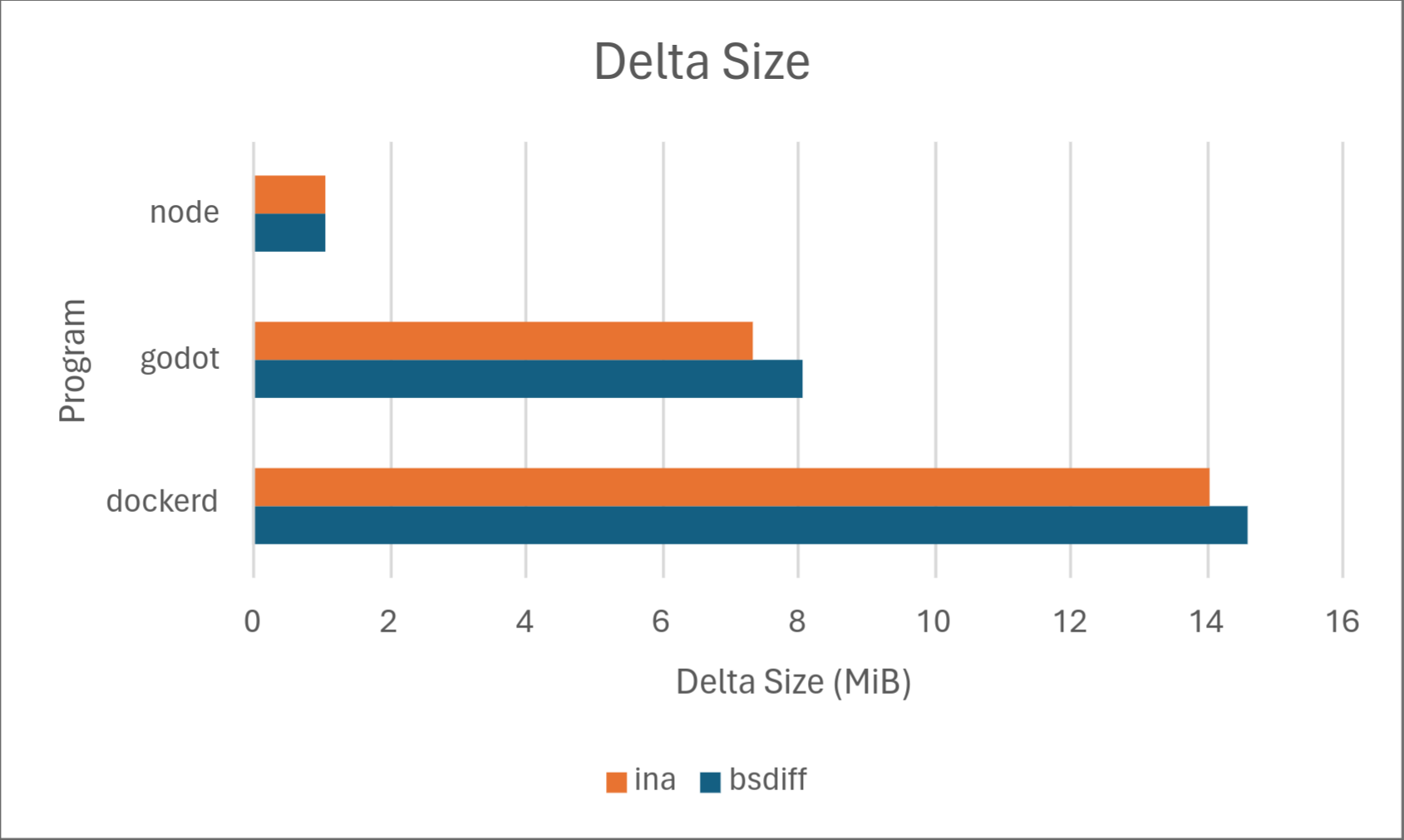
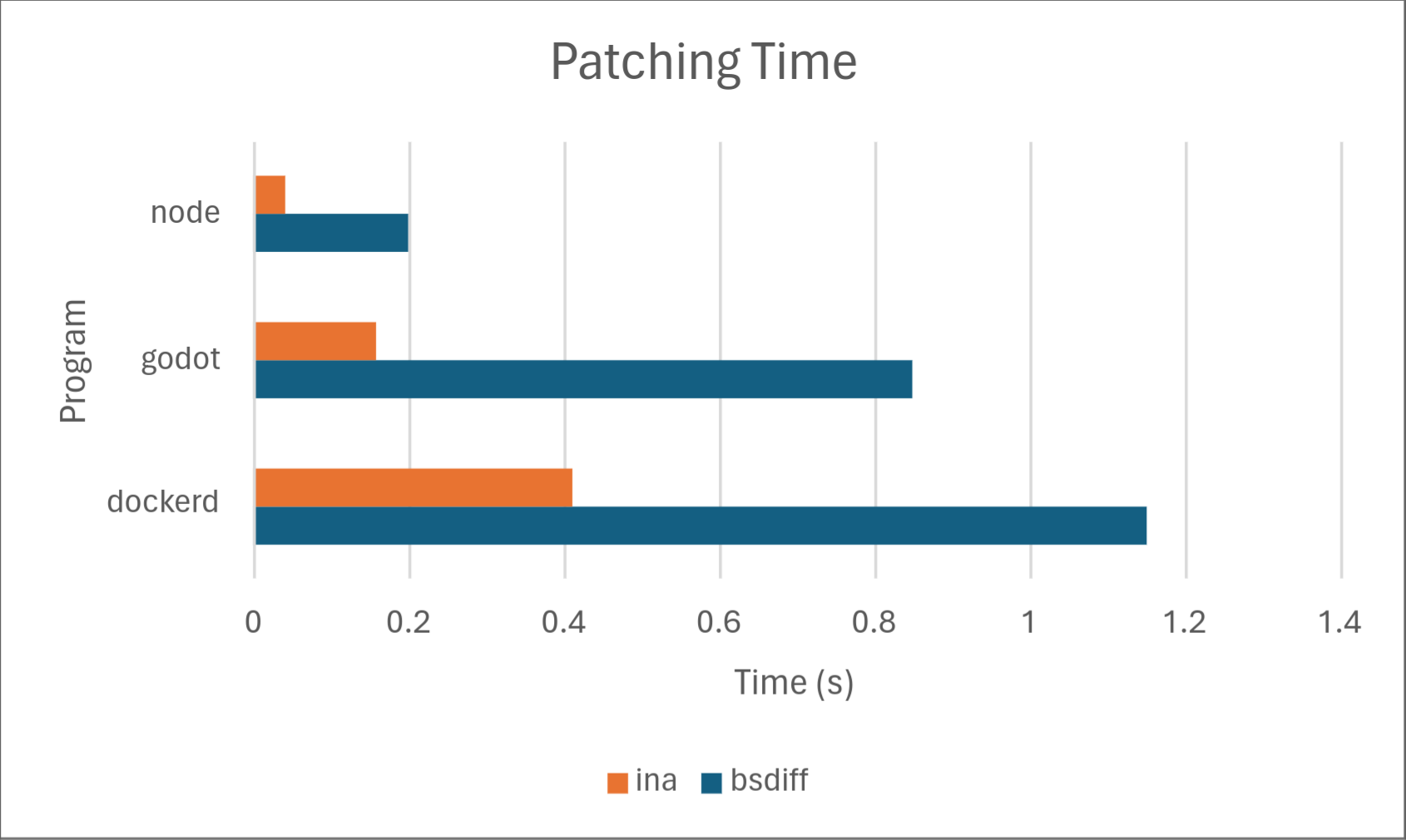
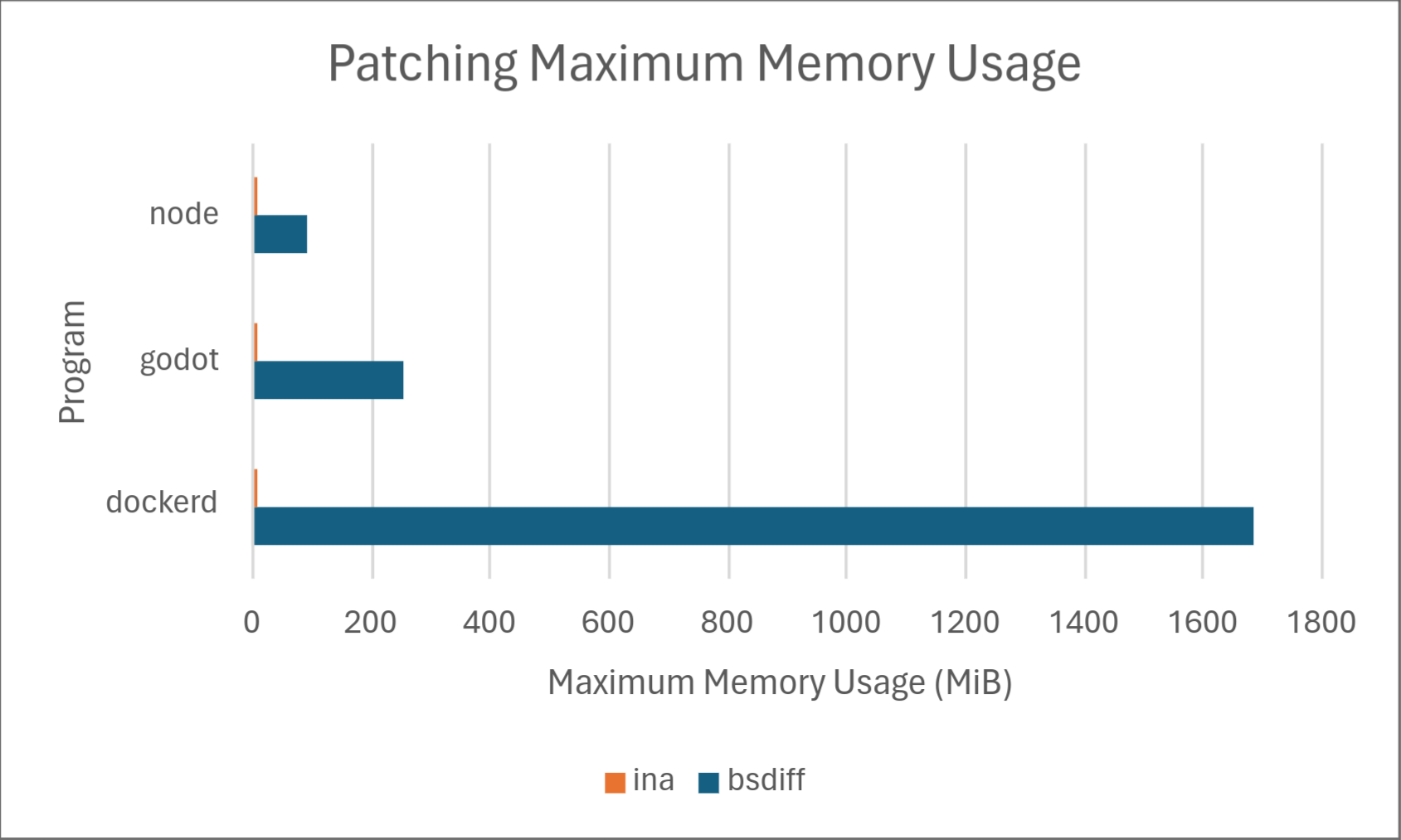
<p>Of course, numbers speak louder than words, so we&rsquo;ve included some results on how Ina stacks up
against the competition, specifically against one of the most common open-source implementations of
delta updates: <a href="https://www.daemonology.net/bsdiff/">bsdiff</a>. Below are the results.</p>
<p>All numbers were taken as an average of 3 runs on an Arch Linux system with an Intel Core Ultra 7
155H processor and LPDDR5 memory running at 6400 Mhz. The original version of bsdiff 4.3 was
compiled with the default Arch package manager compiler flags plus <code>-O3</code>. Ina was compiled in
release mode without any additional compiler flags. Measurements were taken using GNU <code>time</code>. <sup id="fnref1:1"><a href="#fn:1" class="footnote-ref" role="doc-noteref">1</a></sup></p>
<p><img loading="lazy" src="/delta-updates-perf-diff-time.png" alt="Diffing speed performance chart"  />
</p>
<p><img loading="lazy" src="/delta-updates-perf-diff-mem.png" alt="Diffing maximum memory usage performance chart"  />
</p>
<p><img loading="lazy" src="/delta-updates-perf-delta-size.png" alt="Delta size performance chart"  />
</p>
<p><img loading="lazy" src="/delta-updates-perf-patch-time.png" alt="Patching speed performance chart"  />
</p>
<p><img loading="lazy" src="/delta-updates-perf-patch-mem.png" alt="Patching maximum memory usage performance chart"  />
</p>
<h1 id="analysis">Analysis</h1>
<p>Across the board, Ina consistently uses significantly less memory than bsdiff when both diffing and
patching. Diffing time is comparable, with bsdiff taking a slight lead for dockerd, but Ina taking a
drastic lead for node. We don&rsquo;t know the exact cause of this, but may investigate in a later part of
this series. Delta size was comparable between the two programs with Ina taking a slight lead. Ina
took a drastic lead in patching time. However, it should be noted that patching time may not matter
much in practice depending on the hardware because it&rsquo;s so low to begin with.</p>
<h1 id="conclusion">Conclusion</h1>
<p>We&rsquo;ve successfully developed a performant, safe, and robust solution for delta updates to
incorporate into Accrescent. While there are still ways to improve diffing performance and
strengthen the library sandbox, <sup id="fnref1:5"><a href="#fn:5" class="footnote-ref" role="doc-noteref">5</a></sup> we&rsquo;ve already made significant security and performance
improvements over existing delta update solutions and are confident we can implement the additional
improvements we have planned.</p>
<p>In part 2 of this series, we&rsquo;ll explore exactly how Ina achieves its performance characteristics and
perhaps investigate alternative algorithms and performance tricks Ina could take advantage of to
further improve its performance.</p>
<p>That&rsquo;s all for this one! If you want to keep up on more Accrescent developments, join our <a href="https://matrix.to/#/#accrescent-space:matrix.org">Matrix
rooms</a>, follow the <a href="https://accrescent.app/#social">Accrescent socials</a>, or keep an eye on this blog where I&rsquo;ll be posting the next
part of this series on Ina and delta updates.</p>
<div class="footnotes" role="doc-endnotes">
<hr>
<ol>
<li id="fn:1">
<p>All numbers in this post are based on the following Arch Linux x86_64 binaries: dockerd 24.0.7
and 25.0.2, node 20.11.0 and 20.11.1, and godot 4.1.2 and 4.1.3.&#160;<a href="#fnref:1" class="footnote-backref" role="doc-backlink">&#x21a9;&#xfe0e;</a>&#160;<a href="#fnref1:1" class="footnote-backref" role="doc-backlink">&#x21a9;&#xfe0e;</a></p>
</li>
<li id="fn:2">
<p>All active clients with a network connection, of course. Not every client will receive every
update, especially if the software in question updates frequently, as a newer update may be
released before a client attempts to update to the previous release.&#160;<a href="#fnref:2" class="footnote-backref" role="doc-backlink">&#x21a9;&#xfe0e;</a></p>
</li>
<li id="fn:3">
<p>This is called <a href="https://en.wikipedia.org/wiki/Run-length_encoding">run-length encoding</a> (RLE). While not often used on its own, RLE is used in
practice as a part of many popular compression schemes.&#160;<a href="#fnref:3" class="footnote-backref" role="doc-backlink">&#x21a9;&#xfe0e;</a></p>
</li>
<li id="fn:4">
<p>This is an oversimplification. Instructions specifying where to place the changes in the new
binary and which bytes to copy verbatim from the old binary are also necessary, but I decided to
omit this from the diagram as the details of the algorithm will be explained in part 2.&#160;<a href="#fnref:4" class="footnote-backref" role="doc-backlink">&#x21a9;&#xfe0e;</a></p>
</li>
<li id="fn:5">
<p>The original version of this article stated we didn&rsquo;t have Android sandboxing implemented.
Sandboxing was implemented only a few days later, so we updated the text to reflect this.&#160;<a href="#fnref:5" class="footnote-backref" role="doc-backlink">&#x21a9;&#xfe0e;</a>&#160;<a href="#fnref1:5" class="footnote-backref" role="doc-backlink">&#x21a9;&#xfe0e;</a></p>
</li>
</ol>
</div>
]]></content></entry><entry><title>Accrescent has reached public alpha!</title><link rel="alternate" href="https://lberrymage.dev/posts/accrescent-alpha/"/><id>https://lberrymage.dev/posts/accrescent-alpha/</id><published>2022-12-16T00:00:00Z</published><updated>2025-02-17T15:22:17-07:00</updated><summary type="html">&lt;p>As some of you may know, I&amp;rsquo;ve been working on building a new Android app store called &lt;a href="https://accrescent.app">Accrescent&lt;/a>
for &lt;a href="https://twitter.com/lberrymage/status/1475307653089792003">almost a year now&lt;/a>. My goal was to solve the inherent security, privacy, and usability issues
of existing Android app stores by designing a new store from the ground up to address them. Today,
I&amp;rsquo;m proud to announce that Accrescent has entered public alpha! You can try it out yourself today by
downloading it from &lt;a href="https://accrescent.app">our website&lt;/a> or from our &lt;a href="http://github.com/accrescent/accrescent/releases">GitHub releases&lt;/a>.&lt;/p></summary><content type="html"><![CDATA[<p>As some of you may know, I&rsquo;ve been working on building a new Android app store called <a href="https://accrescent.app">Accrescent</a>
for <a href="https://twitter.com/lberrymage/status/1475307653089792003">almost a year now</a>. My goal was to solve the inherent security, privacy, and usability issues
of existing Android app stores by designing a new store from the ground up to address them. Today,
I&rsquo;m proud to announce that Accrescent has entered public alpha! You can try it out yourself today by
downloading it from <a href="https://accrescent.app">our website</a> or from our <a href="http://github.com/accrescent/accrescent/releases">GitHub releases</a>.</p>
<h3 id="what-is-accrescent">What is Accrescent?</h3>
<p>For those who don&rsquo;t know, Accrescent is an open-source Android app store designed from the ground up
to be secure, private, and usable by default. It has first-class support for split APKs without
requiring developers to give up exclusive control of their app signing keys, meaning users get the
size saving benefits of split APKs while developers can rest assured that their keys can&rsquo;t be lost
or abused by Accrescent.</p>
<p>Accrescent builds off this feature further by pinning developers&rsquo; app signing certificates in signed
metadata so that first-time app installs are always verified. This means that even if Accrescent&rsquo;s
servers were compromised, an attacker wouldn&rsquo;t be able to swap out a legitimate app for a malicious
one. Accrescent will simply refuse to install it.</p>
<p>Accrescent also has full support for unprivileged, unattended updates. This means that when app
updates arrive, you won&rsquo;t need to manually approve each one. They happen silently in the background
when you&rsquo;re not using your device, so you don&rsquo;t even need to think about them. This doesn&rsquo;t require
rooting or a special OS - it just works.</p>
<p>Of course Accrescent has other distinguishing features with many more to come. If you&rsquo;re curious
about how Accrescent works and how it stands out from other Android app stores, check out <a href="https://accrescent.app">our
website</a>.</p>
<h3 id="what-does-this-mean">What does this mean?</h3>
<p>Whitelisted developers can now submit their apps to Accrescent through the <a href="https://console.accrescent.app">developer console</a>.
Accrescent is still in the early stages, but this alpha release is a major milestone toward
Accrescent becoming a competitive alternative in the Android app ecosystem.</p>
<p>Accrescent was built to maintain backwards compatability even across major changes, so even though
this release is alpha, no breaking changes are anticipated at this time. If a breaking change
becomes necessary, there will most likely be a transition period for people to update so that most
won&rsquo;t experience breakage.</p>
<h3 id="whats-next-for-accrescent">What&rsquo;s next for Accrescent?</h3>
<p>We have a <a href="https://github.com/orgs/accrescent/projects/2">long roadmap</a> ahead of us. Some of the first priorities are adding app descriptions and
developer information to the store, improving the user experience of the submission process,
displaying app icons, and installing language packs on-demand. If there&rsquo;s a feature you want to see
or a bug you want to report, don&rsquo;t hesitate to create an issue or pull request on our <a href="http://github.com/accrescent">GitHub</a>. We&rsquo;d
love to hear your feedback so that we can make Accrescent a more pleasant and feature-rich user
experience for everyone. We&rsquo;re excited to see Accrescent grow into the flourishing app store we
envision.</p>
<p>Here&rsquo;s to the future!</p>
]]></content></entry></feed>